
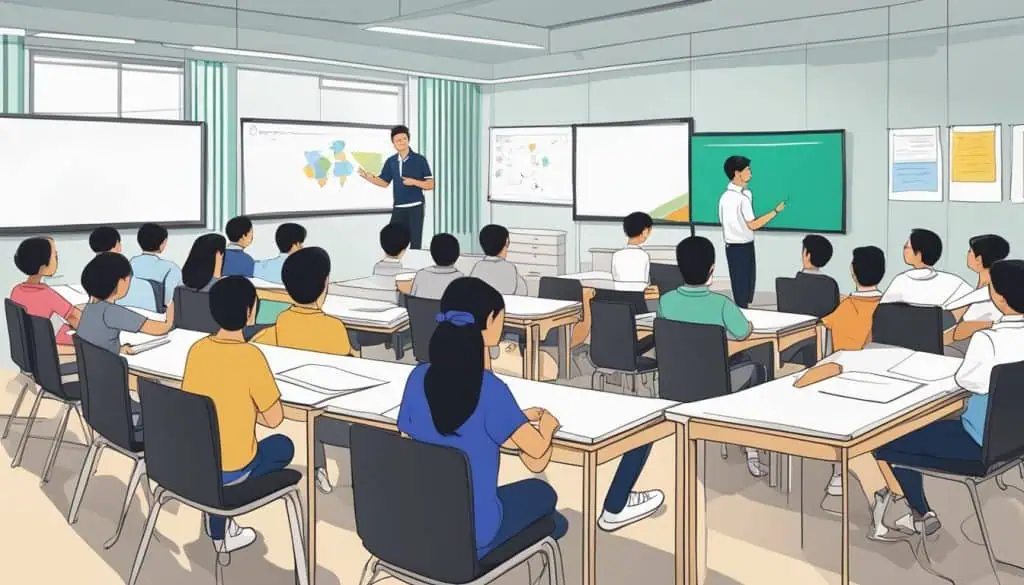
General Paper is not an English exam, and treating it as one is the most common reason students plateau. It tests whether you can build an argument, support it with real-world knowledge, and hold a position under scrutiny. Students with strong English routinely stall in GP, because fluent writing with a thin argument does not score.
That distinction is where any useful diagnosis starts.
What GP actually asks of a student
Two components, testing different things.
The essay asks you to take a position on a question — often social, political, scientific or ethical — and defend it. Marks come from the quality of the argument, the relevance and specificity of the evidence, and the ability to handle the opposing view rather than ignore it.
The comprehension paper tests whether you can read closely, paraphrase precisely in your own words, and write an accurate summary within a word limit. It rewards precision and penalises lifting from the passage.
Both reward thinking that is visible on the page. Neither rewards elaborate vocabulary for its own sake.
Sorting out why the marks have stalled
Most students at a plateau are stuck for one of four reasons, and they need different remedies.
1. Thin or generic evidence. The argument is reasonable but supported by “many studies show” and “in today’s society”. Examples are unnamed, undated and interchangeable across essays. This is the single most common ceiling and it is fixable, because it is a stock problem rather than a thinking problem.
2. No real argument structure. Paragraphs each say something true about the topic, but they do not build. The essay describes the issue rather than arguing a position on it. A useful test: can you state your thesis in one sentence, and does every paragraph visibly serve it?
3. Not engaging the counter-argument. Acknowledging that “some people disagree” and moving on is not engagement. Marks come from taking the strongest version of the opposing case seriously and explaining why your position survives it.
4. Not answering the question asked. Writing the essay on the topic rather than on the specific question. “To what extent”, “is it ever justified”, and “in your society” each demand a different shape of answer, and drifting off them costs heavily regardless of how good the writing is.
If you cannot tell which of these applies, that is itself the finding — and it is what a diagnostic should establish before any teaching happens.
Building evidence you can actually use
This is where the most reliable improvement comes from, and it is the part most students skip because it is unglamorous.
Keep a small, deep bank rather than a wide, shallow one. Ten examples you know properly — specific, dated, with the detail that makes them evidence rather than assertion — beat fifty you can only gesture at.
Choose examples that stretch across question types. A well-understood case in technology regulation, in public health, or in education policy can serve arguments about ethics, governance, inequality and the role of the state. That flexibility is worth more than topic coverage.
Include Singapore. Questions that ask about “your society” are common and the answers that score are specific to here. Generic global commentary underperforms on them consistently.
Update it. Examples that were current three years ago read as stale, and staleness is visible to a marker.
On reading
GP rewards students who read, and there is no shortcut that replaces it. But undirected reading is slow to pay off.
More efficient: read with the question types in mind. When you read about a policy dispute, note who disagrees and on what grounds — that is the raw material for counter-arguments. When you read about a scientific development, note the trade-off, not just the achievement.
The aim is not to accumulate facts. It is to accumulate arguments you have seen made well.
What tuition can and cannot do for GP
It can diagnose which of the four ceilings you have hit, which is genuinely hard to self-assess. It can mark essays against the criteria and show where marks were and were not earned. It can teach essay structure and question analysis, both of which are learnable techniques. And it can force the regular timed writing that most students avoid.
It cannot substitute for reading, and it cannot install a bank of evidence you have not internalised. A tutor supplying pre-packaged examples produces essays that read as pre-packaged, and markers see a great many of them.
The most valuable thing a GP tutor does is mark honestly and specifically. If feedback is consistently “good effort, develop your points more”, that is not diagnosis and nothing will move.
Reading the question before writing the essay
A large share of GP marks are lost before the first sentence, in the thirty seconds nobody spends working out what the question actually asks.
Identify the scope. A question about “technology” and one about “technology in developing economies” are different essays, and answering the broader one when the narrower was set costs heavily throughout.
Notice the qualifier. Words like only, always, primarily and more than set the terms of the argument. An essay that ignores the qualifier answers a question that was not asked.
Work out what would count as evidence. Before choosing a position, ask what kind of example could support either side. If nothing comes to mind, that is the question to avoid — a well-argued essay on your second-choice question beats a thin one on your first.
Decide the position, then check you can defend it for the whole essay. Students commonly pick the side they believe rather than the side they can evidence, and run out of material halfway.
Note the counter-case at the planning stage. Deciding in advance where it goes and how you answer it prevents the common pattern of acknowledging it weakly in the final paragraph.
Two minutes here changes the essay more than any amount of additional vocabulary.
The comprehension paper is the faster gain
Students concentrate on the essay because it feels like the subject, but comprehension technique improves more quickly and the marks count the same.
Paraphrasing is the core skill. Answering in your own words demonstrates understanding; lifting the passage’s phrasing, even accurately, usually earns nothing. The practice is mechanical: cover the text, write the idea, then check.
Summary rewards discipline over style. Identify the points within the defined scope, compress them, stay inside the limit. Students lose marks by including material outside the scope or by running over, and both are fixable in weeks.
Inference questions ask what is implied, not what is stated. Quoting the line containing the implication is not the answer; saying what it implies is.
The application question rewards the same evidence bank the essay uses, which means work on one serves both.
For a student short on time before the examination, comprehension is where a term of focused practice returns most — and it is routinely neglected in favour of essay work that moves slower.
A realistic timeline
Comprehension technique responds relatively quickly — the skills are concrete and practice transfers. Essay marks move more slowly, because they depend on an evidence bank and a habit of argument that accumulate over months.
Students who start in the term before the examination are usually working on technique and question analysis, which is the right choice under time pressure. Students with a year can build the reading and evidence base that produces a larger and more durable shift.
Frequently asked questions
I get good grades in English but not in GP. Why? Because GP is not testing English. Fluent writing with thin argument and generic evidence does not score. The gap is almost always in argument structure or in the quality of evidence, not in language.
How many examples do I need? Fewer than most students think, known far better. Ten well-understood, flexible examples that stretch across question types serve better than a long list you can only mention in passing.
Does GP tuition help with the comprehension paper too? Yes, and it often produces the quicker gain. Summary and paraphrasing are concrete, learnable skills where marking against the criteria shows immediate results.
Can I improve GP without reading more? Structure and question analysis can be taught and will lift a weak script. But the ceiling on essay marks is evidence quality, and that comes from reading. There is no version of this that skips it.
When should I start? If the goal is technique under time pressure, the term before is workable. If the goal is a genuine shift in essay marks, a year gives the reading and evidence bank time to build.
—